

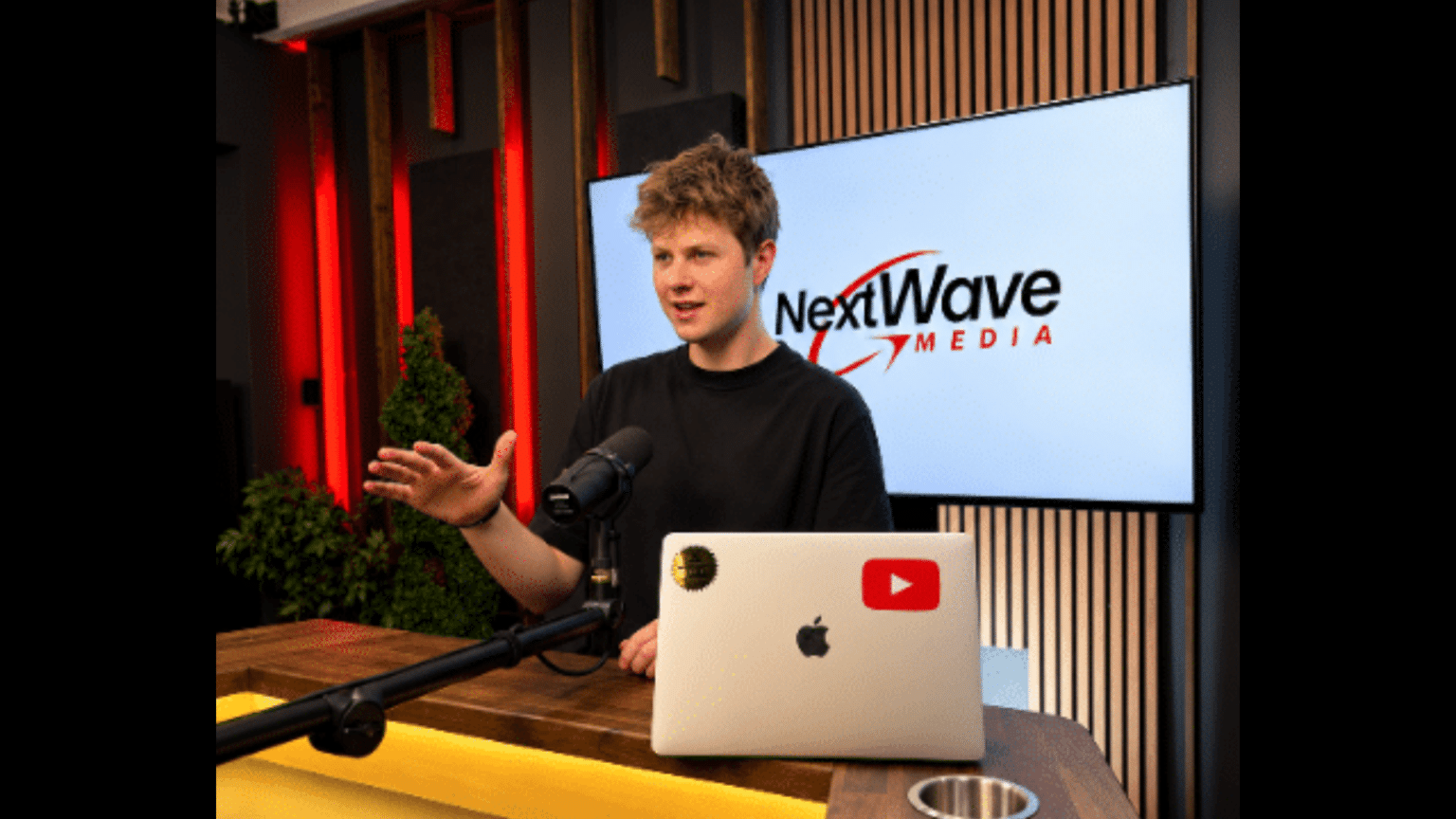
Los Angeles/New York: Hudson Matter, a YouTuber with 2.2 million subscribers, once built YouTube channels for mainstream celebrities under a revenue-share arrangement — fronting the production costs himself. He abandoned the model after finding that talent with no financial stake consistently disengaged when early results were slow. The experience, he says, clarified what YouTube actually requires from those who build on it seriously.
“An authentic YouTube channel won’t get you more eyeballs than ads,” Hudson says. “But what ads won’t get you is connection. Customers want to buy from people who have a connection with their audience.”
That argument is the foundation of NextWave Media, which Hudson launched in late 2024 from offices in Los Angeles and New York. The company advises enterprise brands and creators on YouTube strategy through two service lines: building and operating branded channels end to end, and designing creator partnership programmes for brands better positioned to integrate into an existing audience than build one.
The Measurement Void
The brands that come to NextWave typically arrive with a reach-based case for YouTube and a measurement void. They know the platform reaches three billion viewers monthly, and Hudson says it is the top streaming service on television by a significant margin. What most lack is a working theory of what actually drives performance there. “They don’t understand what a retention graph is or how to optimise for it,” he says. “They don’t understand why that matters.”
The Metrics That Matter
The platform metric Hudson prioritises above all others is new viewers who return for more. A second is average views per viewer, available in YouTube Studio’s advanced analytics, which measures how many of a creator’s videos the typical viewer watches per month.
Together, the two signal whether a channel is building a repeating audience or accumulating one-time clicks. Of the two, returning viewers is the more sensitive signal — it marks the moment a viewer liked something enough to voluntarily seek out more. “My favourite metrics to track are ones that can’t be artificially inflated,” Hudson says.
Brands Still Treat YouTube Like an Impressions Platform
The tactical failure Hudson consistently sees is brands reusing content produced for Instagram and TikTok on YouTube Shorts. “The issue with branded content on YouTube as a whole is that they think about it in the same way of here’s how we make content for other social platforms,” he says.
Hudson’s “70/30” framework holds that 70% of a YouTube video’s success comes from the idea, title, thumbnail and intro, and only 30% from everything else. He notes most brands invert that allocation, whereas MrBeast’s production team does not — finalising title and thumbnail before recording begins. “They wouldn’t even start to plan a video… from a creative standpoint until they had a finished title and thumbnail working,” Hudson says.
Why the Celebrity Model Failed
Under the original model, NextWave funded celebrity YouTube channels, handled production and took a percentage of AdSense revenue. The problem was structural: celebrities who weren’t contributing capital had little incentive to stay engaged when early videos underperformed.
“YouTube takes time. And so you’re not going to be printing money the first month or second month of uploading,” Hudson says. “But with the mainstream world, people kind of forget about that.”
Enterprise brands operate under different priorities — they aren’t measuring success through AdSense income. “It’s about conversion, it’s about brand identity, it’s about building new audiences.” The company is self-funded; Hudson has not raised outside capital, framing the decision as intentional: prove the model through revenue, then raise against that rather than early-stage potential.
Owned Channel or Creator Partnership?
Every engagement at NextWave starts with the same diagnostic: can the brand produce content of its own that will build a repeating audience? For those that can, an owned channel builds the connection advantage Hudson argues YouTube holds over paid advertising. For those that can’t, creator partnerships let them integrate into an audience that is already engaged.
NextWave uses what it calls the “Retention Scalability Methodology,” a proprietary framework that, according to the company, evaluates audience behaviour, content structure and packaging decisions to identify what drives sustainable growth. Its operating principle — “expand the lane, don’t change it” — holds that growth comes from gradually widening a channel’s existing content territory rather than replacing what built the audience.
Case Studies
A completed engagement with basketball creator The Professor illustrates the approach. He came to NextWave with approximately 20–30 million followers across platforms and declining YouTube viewership. NextWave defined his target demographic, analysed what channels that audience was already watching, and modernised his packaging. Viewership per upload roughly doubled or tripled across the first several videos, Hudson says.
The company also applied the principle with Jordan Matter, a YouTuber with more than 38 million subscribers and Hudson’s father. Rather than repositioning the channel, NextWave widened its existing content territory incrementally. According to the company, the strategy generated 78.1 million views in the ten months following implementation — 77 million more than the comparable prior period. A single video, the “Jordan Matter Challenge,” reached 87 million views at 60% audience retention, NextWave reports.
On a separate engagement with a travel creator, the same methodology produced a video that reached 10 million lifetime views at a 10% click-through rate, also according to the company.
The Road Ahead
Hudson’s near-term goal for NextWave Media is to triple the business. Over a longer horizon, he sees YouTube’s trajectory reinforcing the case for treating the platform as a relationship asset rather than a reach channel — expecting the convergence between YouTube and mainstream entertainment to continue. “I think we’ll continue to see more, maybe like shows developed on YouTube,” he says.
His longer-range ambition is for NextWave to become what he describes as the largest creator economy business in the world, eventually expanding through acquisitions into creator management and short-form content. “I want essentially every brand, if they want to build on YouTube, to work with us,” Hudson says.

