

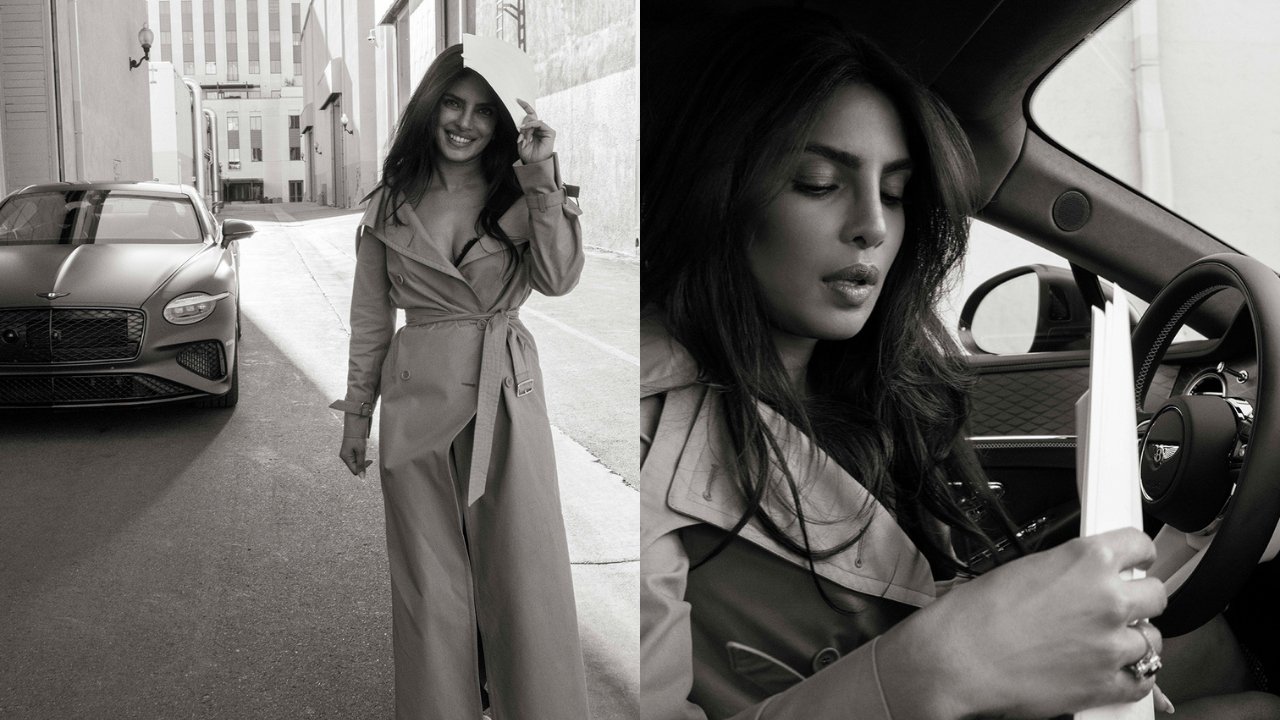
Luxury branding in 2026 is no longer an exercise in amplification—it is an exercise in authorship. The collaboration between Bentley Motors and Priyanka Chopra Jonas, formally announced on April 10, 2026, is not merely another ambassadorial alignment. According to a new analysis from Brand Equity/Economic Times, it represents a structural inflection point in how brands embed themselves within human identity.
What makes this moment significant is not the announcement itself, but what it represents. Bentley is not just associating with a global face—it is constructing what can be described as an identity-led luxury ecosystem.
From Amplification to Authorship
Traditional celebrity endorsements follow a predictable pattern: a famous face lends their image to a product, amplifying its reach. Bentley’s approach with Chopra Jonas is fundamentally different.
| Traditional Endorsement | Bentley’s Approach |
|---|---|
| Celebrity features in campaign | Celebrity anchors the brand’s epistemology |
| Product dominates the frame | Product appears as “silent witness” |
| Campaign has a start and end date | Narrative compounding over time |
| Consumer admires from distance | Consumer locates self within narrative |
In the campaign, the Bentley Continental GT does not dominate the frame. Instead, it appears in fleeting, deliberate compositions—parked along a curb as Chopra Jonas walks past, or gliding through a subdued cityscape. It becomes a “silent witness” to the narrative. The product is not diminished; it is repositioned.
‘I’ve Always Chosen the Road That Didn’t Exist Yet’
This is where the campaign deepens beyond the obvious: it is not about storytelling—it is about story ownership. In a stripped-back moment from the long-format film, Chopra Jonas reflects:
“I’ve always chosen the road that didn’t exist yet.”
The delivery is unembellished—no orchestration, no spectacle. She does not “feature” in the campaign; she anchors its epistemology. Her lived experiences—cinema, entrepreneurship, philanthropy—become the architecture through which the brand is interpreted. Bentley, in this instance, operates less as a manufacturer and more as a curator of identity narratives.
Bentley as Cultural Production House
What is critically new as of April 2026 is that this is not merely a campaign-level shift—it is organizational. With creative collaborators like photographer Greg Williams and Mai Ikuzawa, Bentley is evolving into a hybrid entity:
- Part automotive heritage brand
- Part cultural production house
This evolution is already extending beyond film into adjacent formats:
- Short-form editorial content
- Collectible print narratives
- Emerging digital storytelling formats that mirror art publishing and immersive media
This shift allows Bentley to move beyond being campaign-bound (dependent on periodic bursts of visibility) to becoming culture-bound (existing as a continuous, living narrative within its audience’s cultural consumption).
Narrative Compounding – A Starting Point, Not a Peak
The April 10 announcement is not a peak but a starting point. Teasers, stills, and the long-format film unfold sequentially, encouraging audiences to return, reinterpret, and remain within the narrative arc. This is what the analysis calls “narrative compounding.”
The brand is no longer creating impressions; it is cultivating continuity.
The Geopolitical Recalibration – Why Priyanka Chopra Jonas?
Chopra Jonas is not simply a global celebrity; she is a transcultural node—simultaneously resonant across Hollywood, Mumbai, and global entrepreneurial circuits. This multiplicity is not incidental; it is strategic.
It aligns directly with the rise of the “global nomad” luxury consumer in 2026—individuals whose identities, capital, and cultural affiliations are no longer confined to a single geography.
By anchoring its narrative in a figure who embodies this fluidity, Bentley is positioning itself not just as a car for a place, but as a companion for a way of life that transcends borders.
Aesthetic Restraint – The Power of Quiet Luxury
Another crucial dimension is the campaign’s aesthetic restraint:
| Element | Choice |
|---|---|
| Color palette | Black and white |
| Opulence | Absent |
| Pacing | Deliberate, unhurried |
| Spectacle | Stripped away |
These are not stylistic indulgences but strategic decisions aligned with post-visibility luxury. In an age of hyper-exposure, true luxury signals through control, not excess.
By stripping away spectacle, the campaign creates the illusion of unmediated access. The absence of distraction sharpens attention, making the viewer feel closer, almost complicit.
The Psychological Shift – When Brands Become Identity
Beneath this elegance lies a more complex evolution. When brands move from endorsement to identity, they move closer to psychological integration. The candid tone, the documentary-style framing, the suggestion of authenticity—these are not neutral choices. They are mechanisms that soften the boundary between brand and self.
The question, therefore, is no longer whether consumers will desire luxury. The question is whether they will begin to internalize it.
Behavioral Indicators of Internalization
| Behavior | Description |
|---|---|
| Revisiting campaign fragments | Returning to content multiple times |
| Sharing interpretations | Participating in narrative extensions |
| Seeking personalization | Expecting identity-aligned experiences |
| Co-inhabiting narrative space | Moving beyond consumption to participation |
This behavioral shift is not abstract—it is infrastructural. Communities increasingly manifest within controlled narrative environments:
- Invitation-only digital platforms
- Private brand-led content ecosystems
- Immersive physical experiences (curated driving residencies, salon-style gatherings)
Here, engagement is not measured in impressions but in participation. The consumer does not merely consume the brand—they co-inhabit its narrative space.
Loyalty as Expression, Not Transaction
In this context, loyalty becomes expressive rather than transactional—signaled through presence, interpretation, and cultural alignment.
Chopra Jonas, with her carefully calibrated persona—aspirational yet accessible—becomes the ideal conduit for this shift. She embodies multiplicity. And multiplicity, the analysis argues, is the new currency of luxury. It allows consumers not just to admire, but to locate themselves within the narrative.
Ownership Redefined
This leads to the most critical transformation—one that April 10, 2026, quietly inaugurates. Ownership itself is being redefined.
The consumer no longer engages with luxury as an external acquisition but as an internal alignment. The Bentley is not merely the product. It is the environment—the context—in which a certain kind of life is imagined and performed.
As the analysis concludes:
“When a brand ceases to be something you buy—and becomes something you recognize yourself in—it achieves a permanence that traditional advertising could never engineer.”
The Tension – Empowerment or Quiet Authorship?
Yet this permanence is not without tension. The same mechanisms that make this shift feel intimate can also render it intrusive. When identity and brand begin to converge, the boundary between self-expression and subtle influence becomes increasingly porous.
What feels like empowerment—the ability to see oneself reflected in a brand—can, at its extreme, become a form of quiet authorship exercised by the brand over the consumer’s sense of self.
Luxury as a Statement of Self
Luxury in 2026, according to this analysis, is no longer a statement of status. It is a statement of self.
Bentley’s bet on Priyanka Chopra Jonas is not about her star power—it is about her ability to embody a new kind of luxury consumer: the global nomad who seeks not products, but environments that reflect who they are.
The question is no longer whether this evolution is effective. The question—posed quietly by the campaign itself—is whether it is entirely our own.