

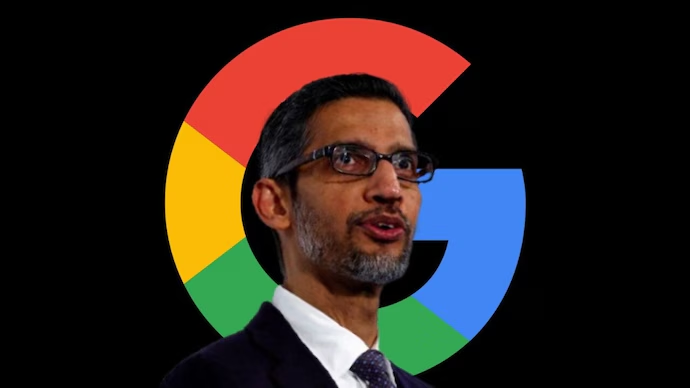
Google and Alphabet CEO Sundar Pichai addressed students at the Indian Institute of Technology (IIT) Madras on Tuesday, acknowledging that fears surrounding artificial intelligence are “completely understandable” but expressing confidence that the technology will ultimately expand — not erase — career opportunities.
“There is anxiety about what AI means for jobs, especially among young people. I understand that completely,” Pichai said during a fireside chat at the institute’s research park. “But every technological shift in history has initially created fear, and then created more opportunities than anyone imagined.”
From panic to proficiency
Pichai drew parallels with the early days of the internet and mobile computing. “When the smartphone first arrived, people were terrified of its impact on attention spans, privacy, social interaction. Today, we can’t imagine life without it — and entire economies have been built on it.”
He argued that generative AI will follow a similar arc: initial panic, followed by gradual integration, and eventually, a period of proficiency where the technology becomes invisible and indispensable.
“The students who learn to use AI as a tool — not as a crutch, not as a threat — will be the ones who build the next Google, the next Microsoft, the next breakthrough,” he said.
No ‘job apocalypse’
Pichai dismissed predictions of a job apocalypse as “overstated.” He noted that while certain tasks will be automated, entire new categories of roles will emerge — many of which do not exist today.
“When I graduated from IIT Kharagpur in 1993, there was no such thing as a social media manager, a cloud architect, a UX designer, or an AI prompt engineer. Those are all jobs that came out of technological shifts. There will be roles in 2030 that we can’t name yet.”
He added that AI will augment human capability, not replace it. “The most powerful outcomes will come from humans plus AI, not AI alone. The intuition, the ethics, the creativity — that remains uniquely human.”
Advice for students
When asked what skills students should focus on, Pichari emphasized problem-solving over coding proficiency.
“Learning to code is still valuable. But more valuable is learning how to break down a problem, how to ask the right questions, how to verify outputs. AI can generate code faster than any human. But AI cannot decide what to build, or why.”
He also urged students not to lose sight of the humanities. “The engineers who succeed in an AI-driven world will be those who understand psychology, ethics, history, and communication. The most successful teams at Google are not just technical. They are empathetic.”
India’s role in the AI revolution
Pichai expressed optimism about India’s position in the global AI landscape. “India has the world’s largest pool of young talent, a thriving startup ecosystem, and a digital infrastructure that is the envy of many developed countries. You can leapfrog.”
He cited Google’s continued investment in AI research centres in Bengaluru and Hyderabad, and the company’s focus on building AI models that work for Indian languages and contexts.
“We are seeing startups in agriculture, healthcare, education, and finance — all using AI to solve problems that are specific to India. That is incredibly exciting. That is the future.”
No direct comment on India’s AI regulations
Pichai, however, did not directly comment on the Indian government’s proposed Digital India AI Framework, which is expected to regulate high-risk AI applications. He noted that “thoughtful regulation” is important but declined to offer specifics.
The bigger picture
Pichai acknowledged that the pace of AI development can feel overwhelming. “It is moving faster than any technology I have seen in my career. That can be unsettling. But it can also be exhilarating.”
He ended with a message of reassurance: “Don’t be afraid. Be curious. The tools are here to help you think bigger, not smaller. And if you can solve real problems for real people, you will always have a place — no matter how smart the machines get.”