
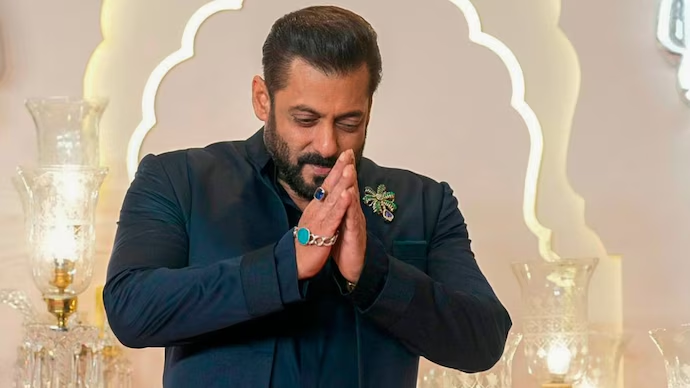
Every brand manager’s nightmare. Every gossip columnist’s dream. Every fan’s unwavering obsession. Salman Khan is not just Bollywood’s biggest star; he is its most spectacular anomaly.
In an era of carefully curated Instagram grids, politically correct statements, and crisis management teams on speed dial, the 60-year-old actor continues to operate like a force of nature — unpredictable, unfiltered, and ungovernable. And that, paradoxically, is his superpower.
The PR nightmare
Let us start with the obvious. Salman Khan has been at the centre of controversies that would have ended any other career. The blackbuck poaching case. The 2002 hit-and-run. Feuds with co-stars. Statements that make his team collectively wince. Legal battles that have dragged on for decades.
In 2015, he was convicted and sentenced to five years in the blackbuck case, only to be acquitted on appeal. In 2018, a Rajasthan court found him guilty again; he spent two nights in Jodhpur jail before securing bail. The case continues to haunt him.
Yet, when ‘Bharat’ released in 2019, it opened to ₹42 crore on Eid. When ‘Dabangg 3’ arrived, fans danced in theatres. When he announced ‘Sikandar’ last year, the buzz was deafening.
“Any other actor would have been finished,” says a veteran film publicist, speaking on condition of anonymity. “But Salman has this unique ability to compartmentalize. His legal troubles exist in one universe, and his stardom in another. Fans have decided that these two things don’t intersect.”
The wild card
If predictability is the hallmark of modern stardom, Salman Khan is the industry’s greatest wild card. You never know what he will say, whom he will praise, whom he will annoy, or which film he will suddenly announce.
In 2021, he called himself “mentally destroyed” during the pandemic and said he had “no work.” The next year, he was shooting back-to-back films.
In 2023, after ‘Kisi Ka Bhai Kisi Ki Jaan’ received poor reviews, he admitted the film didn’t work. Most stars would have deflected. He said, “It’s my fault.”
In 2024, he praised his ex-girlfriend Aishwarya Rai’s performance in ‘Ponniyin Selvan’ when no one expected it. The next week, he was back to being his usual self on ‘Bigg Boss’ — brash, loud, and politically incorrect.
“Salman doesn’t have a filter because he has never needed one,” says trade analyst Komal Nahta. “His relationship with his audience is not based on perfection. It’s based on loyalty. He could say anything, and his fans would still show up on Eid.”
The fan connect
That loyalty is the key. Salman Khan’s fan base is unlike any other in Bollywood. They don’t want him to be polished. They don’t want him to be diplomatic. They want bhai — the protective, flawed, larger-than-life figure who dances at weddings, rescues struggling actors, and builds a fortress of goodwill through his charity, Being Human.
During the COVID-19 pandemic, Salman’s fan clubs organized oxygen supply chains, food distribution, and ambulance services. When he was unwell in 2021, fans held prayer meetings across the country.
“When you have that kind of emotional investment, a few controversies don’t matter,” says social media strategist Vidya Iyer. “His fans see him as family. And family forgives.”
The box office truth
Recent box office numbers tell a more complex story. Not every Salman film works anymore. ‘Kisi Ka Bhai Kisi Ki Jaan’ (2023) collected around ₹110 crore — a hit by any standard but not the ₹200-crore benchmark he once set. The re-release of ‘Maine Pyar Kiya’ (2024) did modest business.
But when he gets it right, like with ‘Tiger 3’ (2023) which collected over ₹450 crore worldwide, he reminds everyone why he is still the king of the Eid release window.
His upcoming slate includes ‘Sikandar’ (late 2026), ‘Kick 2’, and a yet-untitled project with Sanjay Leela Bhansali — his first with the acclaimed director. These films could go either way. That unpredictability is precisely what makes him the most interesting box office case study in Bollywood.
The brotherhood and the critics
Salman Khan has also built an ecosystem. He launched actors like Katrina Kaif, Sonakshi Sinha, and Daisy Shah. He produced films for his brothers Arbaaz and Sohail. He gave struggling actors second chances. He remains the industry’s most generous star, even as critics call his films regressive.
Arbaaz Khan recently revealed: “Salman reads scripts for everyone but himself. He will spend hours listening to a writer’s idea for a newcomer but say yes to his own film in ten minutes. That’s just how he is.”
The bottom line
Salman Khan is not going to change. He will continue to be the headline that makes PR teams sweat and the wild card that makes producers gamble. He will continue to offend, surprise, and occasionally disappoint. And then he will dance in a film that breaks Eid records, and everyone will remember why they fell in love with him in the first place.
In an industry of manufactured perfection, Salman Khan remains gloriously, chaotically, irreplaceably real.