

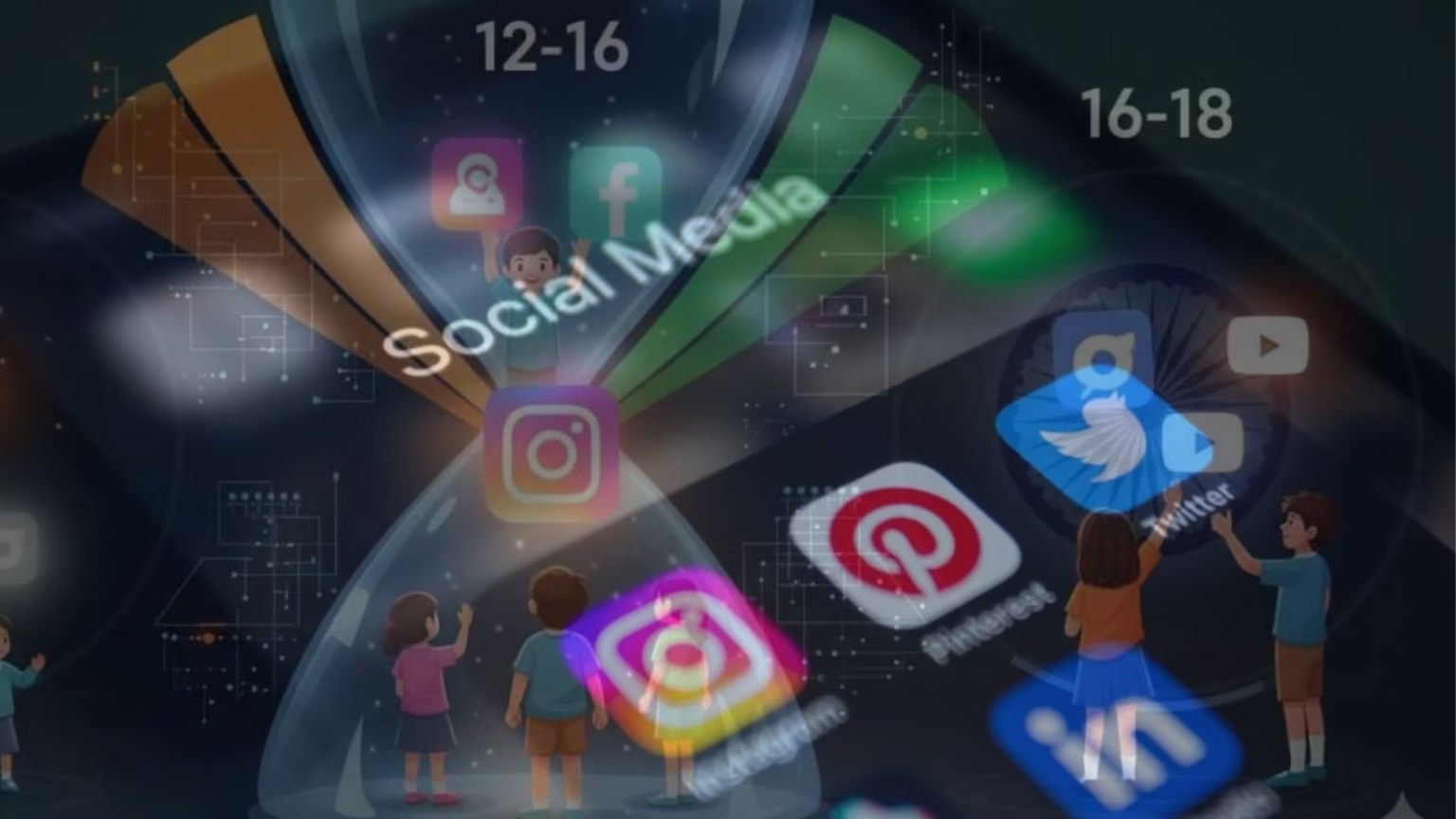
Massive public support and Australia’s world-first law are pushing the UK government toward a historic ban on social media for under-16s.
The UK government is preparing to announce restrictions on children’s access to social media following a government consultation that saw 90% of responding parents support a ban . Prime Minister Keir Starmer has vowed to take “decisive” action, with Technology Secretary Liz Kendall confirming that new measures will be introduced by the end of 2026 .
The Turning Point: Australia’s Precedent
Australia became the first country in the world to ban social media for children under 16 in December 2025 . The law blocks access to platforms including TikTok, Instagram, Facebook, Snapchat, Reddit, X, and YouTube, with non-compliance carrying fines of up to A$49.5 million (approximately $32.8 million) .
This move has been closely watched by governments worldwide. Professor Tama Leaver of Curtin University noted, “While Australia is the first to adopt such restrictions, it is unlikely to be the last. Governments around the world are watching how the power of Big Tech was successfully taken on” .
The Australian ban is currently facing a legal challenge from Elon Musk’s X, which has called it “a backdoor way to control access to the internet by all Australians” . However, most major platforms including Meta have agreed to comply using age verification technologies such as facial scans, ID uploads, or activity inference .
Growing Political Momentum in the UK
Pressure for similar action in the UK has been building across party lines. In January 2026, the House of Lords backed a ban for under-16s by 261 votes to 150, with Conservative leader Kemi Badenoch publicly supporting the move .
Badenoch argued: “We tell children what to do all the time. Children are not adults. Freedom is for adults… Children, we need to protect” . She described social media platforms as being “designed to be addictive” and profiting “from their anxiety, from their distraction.”
More than 60 Labour MPs have also joined Conservatives in urging a ban, creating significant political pressure on the Starmer government .
The Legal Framework Takes Shape
The Children’s Wellbeing and Schools Act received Royal Assent on April 29, 2026, giving the government new powers to restrict children’s access to social media . The Act allows the Secretary of State to introduce regulations requiring providers to prevent or restrict children’s access to services or specific functionalities.
Crucially, the government has committed to acting regardless of the consultation outcome . Minister Olivia Bailey told the House of Commons that the Secretary of State must act following the consultation, not “may” . The government must publish a progress report within three months of Royal Assent, with the first regulations expected to be laid before Parliament by the end of 2026 .
Why Now? The Drivers Behind the Ban
1. Rising Evidence of Harm
Campaigners and bereaved families have mounted increasing pressure on the government, with some insisting their children died as a result of social media use . Former Tory schools minister Lord Nash called children’s social media use a “societal catastrophe,” linking it to mental health problems, online radicalisation, and disruptive behaviour in classrooms .
2. Existing Laws Deemed Insufficient
The UK already has the Online Safety Act 2023, which requires tech companies to take steps to stop children seeing harmful content . However, critics argue this is not enough. Badenoch stated that children are “spending so many hours a day on platforms that are profiting from their anxiety” .
3. Public Demand
The government’s consultation on children’s digital wellbeing—which closed at the end of May 2026—received overwhelming support for a ban. Nine in 10 responding parents backed restricting under-16 access to social media .
4. Concerns About Addictive Design
The government is particularly focused on “addictive features” such as autoplay, infinite scrolling, and algorithmically driven content that can be harmful to children’s wellbeing . Proposed restrictions could include limits on screen time, time-of-day access restrictions, and bans on features that facilitate contact with unknown users .
What Form Will the Ban Take?
The government is considering two broad options :
- A “blanket” ban on under-16s using social media entirely
- Age restrictions on key features of social networks and apps
Technology Secretary Liz Kendall confirmed that “a ban is on the table” . The government is also looking at how age verification tools—already introduced in Britain in 2025 to restrict adults’ access to pornography sites—could be repurposed for social media .
The Act specifies that restrictions may include :
- Limits on the amount of time children may spend on services
- Limits on the times of day services may be accessed
- Restrictions on functionalities that facilitate contact with unknown users or exposure to live or location-based features
Opposition and Concerns
The proposed ban is not without its critics. Some peers have urged caution, arguing that a blanket ban could push teenagers towards “less regulated platforms” . Others worry it would deprive children of the positive aspects of social media, including community-building and educational content.
Charities including the NSPCC have said a full ban risks “unintended consequences” and have called instead for stronger enforcement of existing child safety rules . UNICEF has similarly cautioned that age bans alone won’t suffice, urging platform redesigns for safer environments and digital literacy education for parents .
What’s Next?
- Summer 2026: The government will publish its response to the consultation
- By end of 2026: New regulations are expected to be introduced
- The government has up to 12 months from the progress statement to lay regulations before Parliament, with a 6-month extension possible only in exceptional circumstances
For social media platforms, the message is clear: prepare for significant changes to how under-16s access your services in the UK, or face substantial penalties.