

Three years after the World Health Organization declared an end to the COVID-19 global health emergency, member states remain deadlocked on how the world will share pathogen samples and genetic data needed to develop vaccines and treatments for the next pandemic.
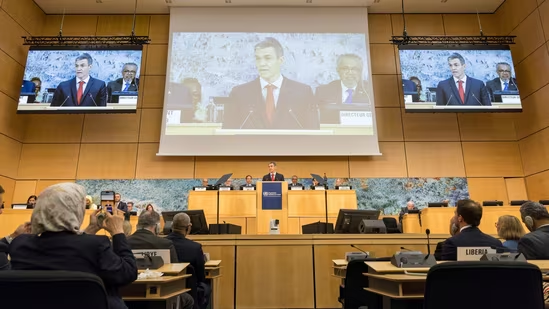
Negotiations on the Pathogen Access and Benefit Sharing (PABS) system – the unfinished annex of the WHO Pandemic Agreement adopted in May 2025 – again ended inconclusively at the 79th World Health Assembly in Geneva .
Member states have agreed to continue negotiations under the Open-Ended Intergovernmental Working Group (IGWG), with the next meeting scheduled for July 2026 .
The core of the impasse
At the heart of the deadlock is a fundamental tension between developed and developing nations.
Developed countries – including the European Union, Norway, Switzerland, the United Kingdom, Australia, Canada, Japan and South Korea – have pressed for rapid, and in some formulations anonymous, sharing of pathogen materials and digital sequence information into the global system .
They have resisted requiring users – pharmaceutical companies, genomic firms, and other commercial recipients – to sign enforceable standard contracts with the WHO setting out their access and benefit-sharing obligations.
Developing countries argue this would oblige them to surrender pathogen data with no enforceable guarantee that vaccines and treatments built on that data would be made available to them .
Access vs benefit-sharing: the key fault line
The most contentious issue concerns the timing of benefit-sharing obligations.
Developing countries have consistently argued that benefit-sharing commitments must be undertaken at the point of access to pathogen materials and sequence data. The demand is not for upfront payment, but for PABS participants to first agree to share benefits, then access and use biological resources, and finally share benefits when they materialise .
Developed countries, by contrast, are pushing for a model where benefit-sharing is negotiated later – possibly only at the point of commercialisation. This effectively delinks access from obligations, creating a system where biological materials and information flow freely while benefits remain uncertain .
“Without upfront commitments, there is no incentive for users to voluntarily assume obligations at a later stage,” policy analysts note. “The negotiating leverage of resource providers and the WHO is strongest at the point of access; once resources have been utilised, that leverage diminishes significantly” .
What is at stake
The PABS system is intended to ensure, on an equal footing, the rapid sharing of pathogens with pandemic potential and the fair and equitable sharing of benefits arising from their use – such as vaccines, diagnostics and therapeutics .
Finalising the PABS Annex is necessary for countries to proceed with signature and ratification of the Pandemic Agreement. Without consensus, the entire agreement remains in limbo .
Article 12 of the agreement commits parties to placing access to pathogens and benefit-sharing on an “equal footing” .
Unresolved issues
Beyond the core access-benefit sharing divide, several other issues remain unresolved:
Vaccine set-asides – Developing countries are seeking guaranteed access to a percentage of vaccines, therapeutics and diagnostics during Public Health Emergencies of International Concern (PHEICs), not just during full pandemics .
The EU has shown willingness to consider such provisions, but Switzerland, the United Kingdom, and Japan continue to oppose fixed percentages .
Production and supply licences – Developing countries want enforceable commitments for technology transfer and licensing agreements that would allow local manufacturing. Developed countries prefer voluntary arrangements “on mutually agreed terms” .
Monetary contributions – There is no consensus on financial benefit-sharing tied to revenue from products developed using shared pathogen data.
WHO chief warns of urgency
WHO Director-General Dr Tedros Adhanom Ghebreyesus acknowledged the progress made but urged countries to continue working with a sense of urgency.
“Real progress was made on the PABS annex and I am confident through continued negotiations differences will be overcome,” Tedros said. “Member States should continue approaching the outstanding issues with a sense of urgency because the next pandemic is a matter of when, not if” .
He added that the PABS annex is “the last piece of the puzzle not only for the Pandemic Agreement but all initiatives that WHO and Member States have implemented as a result of lessons learned from the COVID-19 pandemic” .
Who is being blamed?
According to the non-profit Third World Network, the developed-country bloc has increasingly sought to portray developing countries as responsible for the impasse. Developed-country delegations have framed their stand as one of urgency, flexibility and pragmatism .
“The effort to portray developing countries as responsible for the current deadlock ignores the reality of these negotiations,” said Guilherme Faviero, director at the AHF Global Public Health Institute. “Key developed countries have repeatedly delayed progress and remained unjustifiably resistant to common-sense proposals intended to operationalize equity” .
What happens next
The IGWG will hold its seventh meeting from 6 to 17 July 2026 . The outcome of further negotiations will be presented to the World Health Assembly, which will be asked to consider continuing the IGWG’s work and submit the final outcome to the next Assembly in May 2027, or earlier through a special session of WHA in 2026 .
For now, the pandemic pact – hailed as a historic achievement when adopted in May 2025 – remains paralysed, unable to move forward until its member states can agree on who gets what, when, and how.