

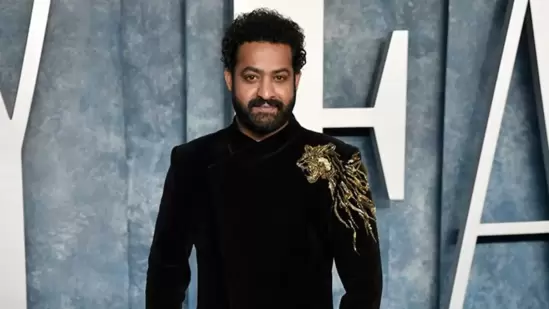
Actor Jr NTR, who achieved pan-India stardom with ‘RRR’ (2022) and the ‘Devara’ franchise, has made a powerful statement about the changing landscape of Indian cinema.
In a recent media interaction, the Telugu superstar declared: “There’s no Bollywood, Tollywood or Mollywood anymore. It’s just Indian cinema now.”
What Jr NTR said
The actor elaborated on his statement, explaining how language barriers have dissolved in the age of OTT and pan-India releases.
“The audience doesn’t care which language a film is originally made in. If the story connects, they will watch it. A Malayalam film gets equal love in Bihar. A Tamil film breaks records in Bengal. A Hindi film finds its biggest audience in Andhra. So why are we still dividing ourselves into Bollywood, Tollywood, Mollywood?”
He added, “We are one industry. We make Indian films. The sooner we accept this, the faster our cinema will grow globally.”
The context behind the quote
Jr NTR’s statement comes at a time when Indian cinema is witnessing unprecedented cross-pollination. ‘Pushpa 2’, ‘Kalki 2898 AD’, ‘Jawan’, and ‘RRR’ have all performed strongly across all language versions.
The actor himself experienced this firsthand. ‘RRR’, made in Telugu, became a nationwide phenomenon and won an Oscar for ‘Naatu Naatu’. Its Hindi dubbed version earned over ₹250 crore – more than many pure Hindi blockbusters.
“During ‘RRR’ promotions, I went to Delhi, Kolkata, Varanasi. People came up to me and said they loved the film. Not the Telugu film. Not the dubbed film. Just ‘the film’. That’s when I realised – language labels don’t matter to audiences anymore,” he recalled.
Breaking down the old labels
Traditionally, Indian cinema has been classified by language:
- Bollywood – Hindi cinema based in Mumbai
- Tollywood – Telugu cinema based in Hyderabad
- Kollywood – Tamil cinema based in Chennai
- Mollywood – Malayalam cinema based in Kochi
- Sandalwood – Kannada cinema based in Bengaluru
Jr NTR argues that these labels, once useful for industry classification, now serve only to divide audiences and limit ambition.
The OTT effect
Streaming platforms have played a major role in erasing linguistic boundaries. A viewer in Lucknow can watch a Malayalam film with Hindi dubbing or subtitles with one click. A viewer in Chennai can discover a Marathi film.
“OTT has democratised content. The audience has become language-agnostic. They care about story, performance, and emotion – not which industry produced it,” Jr NTR said.
He pointed to recent examples: the Malayalam film ‘Manjummel Boys’ became a hit in Hindi, while the Tamil film ‘Maharaja’ found audiences across the country.
Industry reactions
Jr NTR’s quote quickly went viral on social media, with many filmmakers and actors echoing his sentiment.
Filmmaker SS Rajamouli, who launched Jr NTR in ‘Student No.1’ and directed him in ‘RRR’, replied: “Completely agree. Indian cinema has no borders.”
Actor Kamal Haasan posted: “Long ago I said we are one industry. Glad the younger generation feels the same.”
However, some industry veterans offered a cautious counterpoint. “While the sentiment is beautiful, we must not erase the unique cultural identities of each language industry. A Marathi film feels different from a Punjabi film. That diversity is our strength,” said a senior producer.
What this means for the future
Jr NTR’s statement is not just philosophical – it has practical implications. More producers are now making films with multiple language releases planned from day one. Dubbing quality has improved. Marketing campaigns are national, not regional.
The actor himself is currently shooting for his next film, tentatively titled ‘NTR30’, which will release in Telugu, Tamil, Hindi, Kannada, and Malayalam simultaneously.
“We are not making a Telugu film that will be dubbed. We are making an Indian film in Telugu. That’s the difference,” he explained.
Final word from Jr NTR
Ending his thought, Jr NTR said: “Let’s stop limiting ourselves. A filmmaker from Kerala should dream of his film playing in Kashmir. An actor from Bengal should imagine his face on a billboard in Chennai. This is the moment for Indian cinema to unite and conquer the world.”